
Executive Summary
Ask a data leader what their modernization program delivered last quarter and the answer usually involves migrated workloads, new pipelines or a dashboard rollout. Ask what it was worth in dollars, hours saved, or decisions made faster and the room gets noticeably quieter. That gap, between technical progress and demonstrated value, is now the single biggest risk to sustained investment in data, analytics and AI.
Gartner’s Chief Data and Analytics Officer research found that only 22% of organizations have clearly defined, tracked, and shared business-impact metrics for the majority of their data and analytics projects, even though 90% of leaders name delivering tangible value as their top priority for the past 12 to 18 months. The platforms are getting built. The proof isn’t following at the same pace.
This isn’t a problem you solve with one more dashboard. It’s an operating discipline, one that has to be designed into the modernization program from day one, not bolted on after the platform ships. Organizations that build this discipline consistently earn more durable executive sponsorship and more room to keep investing.
In this article
- The Shift
- Our Approach: Building a Value-Driven Data Foundation
- Where This Breaks Down in Practice
- Making It Real
- The Value
- What’s Next for Data leaders
The Shift
For most of the last decade, data modernization was justified in infrastructure terms: migrate off legacy systems, consolidate platforms, enable self-service, get ready for AI. Those were reasonable arguments in 2018. They no longer clear the bar with a CFO in 2026.
Nearly a third of Chief Data and Analytics Officers now name the inability to measure data, analytics, and AI impact as their single biggest challenge. The stakes have grown alongside AI spend: a late-2025 Gartner survey of data, analytics, and AI leaders found that only 39% are confident their current AI investments will meaningfully improve financial performance, while organizations that do report strong AI outcomes invest up to 4x times more in the underlying data foundation than those that don’t. Value doesn’t show up despite the platform. It shows up because of deliberate work done around the platform, well before the AI use case is the headline.
The practical implication is simple to state and hard to execute: “we modernized the data platform” is no longer an outcome. “We cut time-to-insight from three weeks to three days” is. Leading organizations have made exactly this shift, from tracking what got deployed to tracking what changed for the business as a result of deploying it.
Our Approach: Building a Value-Driven Data Foundation
Across our modernization engagements, we observe that the organizations that sustain executive sponsorship share one habit: they treat value measurement as an operating capability, not a one-time business case built to win initial budget approval. That capability rests on four connected disciplines.
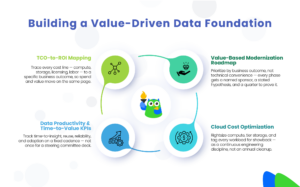
- Value-Based Modernization Roadmap
Instead of sequencing initiatives by technical convenience (for eg: migrate the warehouse, then the pipelines, then the BI layer), sequence them by the business outcome each phase is meant to unlock: faster underwriting decisions, reduced claims leakage, quicker patient-risk stratification, tighter fraud detection, whatever matters most in your business. Every phase should carry a named business sponsor, a stated hypothesis about the outcome it will move, and a defined way to tell within one or two quarters whether that hypothesis held. A simple matrix weighing expected business value against delivery complexity is usually enough to force the prioritization conversation that purely technical roadmaps tend to avoid.
- Cloud Cost Optimization
Cloud flexibility comes with a cost curve that only bends downward with active management. A recent State of the Cloud Report found that wasted cloud spend climbed to 29% of infrastructure spend, a five-year high, driven largely by AI workloads landing on top of environments that were never fully optimized to begin with. Rightsizing compute, tiering storage by access frequency, committing to reserved or spot capacity where workloads allow, and tagging every workload for showback or chargeback are no longer quarterly cleanup exercises. They need to run as a continuous engineering discipline with a named owner, not a periodic finance mandate. Encouragingly, the same report found that organizations tracking cloud value delivered to business units, not just cost saved, jumped twelve points year over year to 64%, and use of unit economics like cost-per-transaction or cost-per-customer rose to 49%. Cost and value are increasingly being measured together, and that pairing is what keeps optimization from sliding into indiscriminate cost-cutting.
- TCO-to-ROI Mapping
Total Cost of Ownership answers “what are we spending.” It doesn’t answer “what are we getting.” Closing that gap means building a traceability line from specific cost line items (compute, storage, licensing, integration effort, run-the-business labor), to specific business outcomes: hours of analyst time reclaimed, faster loan or claims decisions, fewer manual reconciliations, higher straight-through processing rates. This mapping doesn’t need to be perfectly precise to be useful. It needs to be consistent enough that the same TCO dollar traces to the same value bucket every quarter, so trends are comparable rather than reinvented each budget cycle.
- Data Productivity and Time-to-Value KPIs
The KPIs that matter here are operational, not architectural: time-to-insight, data product reuse rate, pipeline reliability, self-service adoption among business users, cycle time from raw data to production-ready data product, and AI or model deployment velocity. None of these require exotic instrumentation. Most can be pulled from existing pipeline orchestration, catalog, and BI adoption logs. The discipline is in reviewing them on a fixed cadence, alongside cost and business-outcome metrics, rather than producing them once for a steering committee deck and letting them go stale.
Where This Breaks Down in Practice
Three patterns show up repeatedly in programs that struggle to demonstrate value, even when the underlying platform work is technically sound. First, value tracking has no named owner, so it sits with whichever analyst has time that week and is the first thing dropped under deadline pressure. Second, metrics get defined after the platform is already live, leaving no baseline to measure improvement against, only a snapshot with nothing to compare it to. Third, the KPIs that do exist stay inside a data team dashboard and never reach a business or finance audience in language they use day to day, so they influence nothing when budget decisions actually get made.
Making It Real
Consider a pattern that shows up across modernization programs regardless of industry: a data platform migration scoped and budgeted purely on infrastructure terms, for example, lift-and-shift a warehouse, decommission legacy ETL, stand up a semantic layer. Six months in, the platform is live, but no one can say with confidence whether it moved the business. Retrofitting a value lens at that point means going back to identify two or three flagship use cases the new platform now enables. It could be a faster underwriting turnaround, a self-service reporting layer that eliminates a recurring manual data pull and then instrumenting time-to-insight and adoption for just those use cases first. It’s a smaller, later, and harder version of the same work a value-based roadmap would have built in from the start. Organizations that define the outcome hypothesis and the KPI baseline before the first migration ticket is even cut, consistently spend less time retrofitting the story after the fact, and more time acting on what the numbers tell them.
The Value
Done well, this shifts the entire conversation with the business. Modernization stops being a technology line item competing for budget against every other initiative, and starts being a portfolio of investments with visible, trackable returns, expressed in the same financial language the CFO already uses. Analytics, BI, and AI initiatives become easier to prioritize because their contribution is measured, not asserted. And because cost and value are tracked side by side, cost optimization stops being a defensive, once-a-year exercise and becomes evidence that the organization is spending well, not merely spending less.
What’s Next for Data leaders
Start by:
- Defining the two or three business outcomes your current modernization initiative is actually meant to move, before evaluating another tool or platform.
- Build a simple scorecard spanning financial, operational, and business dimensions, and review it on the same cadence as your budget conversations, not once a year in a retrospective.
- Over time, the goal is to shift from reporting project milestones to reporting business results: a platform that’s live is a starting point, not a finish line.
Organizations that build this muscle now won’t just optimize what they spend on data and AI. They’ll be able to show, quarter after quarter, exactly what that spend is buying them.
We at OwlSure help organizations modernize their data and analytics foundations. Across industries including healthcare, insurance, banking, lending & leasing, we partner with clients to optimize cloud costs, connect TCO to ROI, and accelerate time-to-value from their data and AI investments. Click here, to get started on your Data, Analytics and AI journey with experts from OwlSure.
Author:
Renji Krishnan, Senior Product Marketing Manager