

It happens every day in every organization, yet almost no one measures its true cost.
An employee needs information to complete an important task. They know it exists but not where to find it.
A loan officer at a mid-sized bank searches for the latest lending policy before meeting a client, only to find three different versions spread across shared drives and email threads.
An insurance claims ‘adjuster knows a revised rate table exists but spends the next fifteen minutes messaging colleagues and searching for multiple systems before locating the right version.
A nurse manager needs the latest infection-control protocol during a busy shift, but there’s no single trusted place to access the most current guidance.
A university registrar receives a financial-aid appeal form, only to discover it’s an outdated version from two academic years ago. The challenge is no longer processing the request, but determining which version is actually valid.
Different industries. Different roles. The same underlying problem.
Not because employees lack skills. Not because the information doesn’t exist. But because enterprise knowledge is scattered across disconnected systems, shared drives, collaboration platforms, emails, and business applications that were never designed to work as one.
Every minute spent searching, verifying, or second-guessing information is time taken away from serving customers, supporting employees, making decisions, or delivering better outcomes.
As organizations continue investing in new digital workplace technologies, information often becomes easier to create, but harder to discover. Employees end up navigating systems instead of using knowledge, turning what should be simple tasks into unnecessary delays.
The math behind the ‘Information Cost’ that nobody factors into the yearly budget.
Information is one of the most valuable assets an organization owns. Yet the cost of accessing it is rarely measured.
Research consistently shows that employees spend a significant portion of their workday searching for information instead of applying it to the work that creates value.
According to McKinsey’s research, employees spend an average of 1.8 hours every day and about 9.3 hours per week, searching for and gathering information they need to do their job. IDC’s analysis estimates the figure is even high for knowledge workers: about 2.5 hours a day.
These aren’t software costs that appear in an IT budget. They are productivity costs hidden inside payroll.
Consider a conservative example.
If a knowledge worker costs an organization approximately $75 per hour and spends 90 minutes each workday searching for information instead of using it, that’s nearly 375 hours a year spent looking for knowledge. At a fully absorbed labor cost, that represents more than $28,000 per employee annually in lost productivity.
Now multiply that across hundreds or thousands of employees.
Suddenly, “I don’t know where to find that” is no longer a minor workplace frustration. It’s an invisible operational cost that quietly affects productivity, customer service, decision-making, and business performance across the organization.
The problem isn’t that organizations have too much information. It’s that information is fragmented.
Knowledge now lives across collaboration platforms, business applications, shared drives, email, and countless departmental repositories. Every new system may solve a specific business need, but it also creates another place employees need to search, another version to verify, and another source to trust.
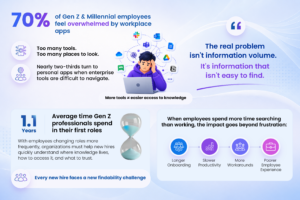
What do employees expect today:
Search less. Find faster. Trust what they find.
Today’s workforce expects workplace technology to feel as intuitive as the consumer applications they use every day. The digital workplace needs to make trusted knowledge discoverable, contextual, and accessible—wherever it resides.
Why information findability matters: rethinking the traditional intranet.
Lost productivity is only the most visible consequence of poor findability. The bigger impact is what happens after the search.
When employees can’t confidently access the right information at the right time, organizations don’t just lose minutes, they introduce delays, duplicate effort, increase operational risk, and slow decision making. These costs rarely appear as individual budget line items, but together they create significant enterprise-wide friction.
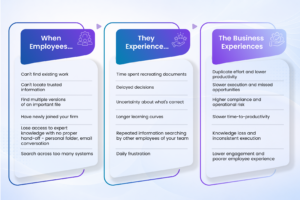
The same challenge exists across every industry. This isn’t unique to banking, insurance, healthcare, or education.
It’s a challenge shared by organizations whose information has grown faster than the digital workplace designed to organize it. As enterprises adopt new business applications, collaboration platforms, content repositories, and communication tools, information becomes increasingly distributed. Employees must often know where knowledge lives before they can begin searching for it.
Traditional intranets were originally created to address this challenge by providing a central place to store and access organizational information. Over time, however, they evolved primarily into publishing and information-sharing channels rather than the collaborative, connected digital workplaces employees need today. Modern digital workplaces require intranet platforms that go beyond simply publishing information to make it discoverable, contextual, and trustworthy, regardless of where it resides.
How can organizations close the information discovery gap?
Adding another workplace application isn’t the answer. Employees don’t need more places to search for. They need one trusted digital workplace where information is easy to find, regardless of where it resides.
This is where a modern intranet differs from a traditional one.
Rather than functioning as a static repository for documents and announcements, a modern intranet acts as an intelligent digital workplace. It connects people, knowledge, and business systems to deliver relevant information in the context of their work.
A modern intranet helps organizations by:
Helping employees find trusted information faster
Enterprise search brings together documents, policies, people, and organizational knowledge from across connected systems, reducing the time spent switching between applications or searching multiple repositories.
Delivering personalized experiences
Role, department, and location-based personalization surfaces the information most relevant to each employee, minimizing information overload and making daily work more efficient.
Improving information trust and governance
Content lifecycle management and governance ensure employees access current, approved information while reducing the spread and use of outdated content.
Connecting existing business systems
Instead of replacing enterprise applications, a modern intranet integrates with HR, IT service management, collaboration, and business platforms to create a unified digital workplace where knowledge is easier to discover and use.
This is the approach behind OwlSure’s Modern Intranet Platform designed to help organizations reduce information fragmentation and make trusted knowledge easier to discover across the digital workplace.
The real question isn’t whether information is scattered. It’s what it is costing your business.
Every organization creates knowledge. The organizations that move faster aren’t the ones with the most information, but the ones where employees can quickly find, trust, and act on it.
As digital workplaces become increasingly complex, information discoverability is no longer just an employee experience initiative or an IT priority. It’s a business capability that improves productivity, accelerates decision-making, strengthens compliance, and enables employees to work with greater confidence.
The challenge isn’t creating more information. It’s ensuring the knowledge your organization already has is accessible, trusted, and easy to discover when employees need it most.
Making trusted knowledge easier to discover.
OwlSure’s Modern Intranet Platform helps organizations transform fragmented information into connected knowledge by bringing people, content, and enterprise systems together in one intelligent digital workplace.
If you’re looking to improve information discoverability, reduce operational friction, and deliver a more connected employee experience, explore how OwlSure’s Modern Intranet Platform can help.