

Executive Summary
Every organization today runs on data that powers their dashboards, insights, and AI models. Yet many data leaders will admit: one of the biggest blockers to the business isn’t a lack of data, but the unreliability of the pipelines delivering it. Frequent breakages, manual fixes, and delays erode trust in analytics, slowing down decision-making and innovation.
As enterprises scale across cloud and hybrid environments, maintaining consistent, high-quality data delivery has become a complex challenge. That’s where DataOps comes in – an agile, automated approach to managing the data lifecycle. By applying CI/CD, observability, and intelligent orchestration, DataOps transforms fragmented data operations into a continuously reliable system. The result: dependable, production-grade data delivery for BI, analytics, and AI at enterprise scale.
Why Data Reliability Demands an Operational Approach
Reliability can’t be achieved by toolsets alone. It requires operational discipline with automation, monitoring, and governance working together to keep data moving seamlessly. Research shows that organizations with mature DataOps practices deliver data 5–7x faster and experience up to 30% fewer pipeline failures.
The lesson: it’s not enough to build data pipelines. They must be engineered to perform continuously. This shift ensures consistent and high-quality data powers- analytics dashboards, regulatory reports, and AI models alike.
Four Practices for Operationalizing Reliability through DataOps
In our modernization programs, we’ve seen that embedding automation, observability, and CI/CD principles can reduce pipeline incidents and cut weeks off the time-to-insights. More importantly, DataOps maturity creates a direct bridge to AI readiness, because data reliability determines model reliability.
A practical roadmap for operationalizing reliability can be built on four interconnected practices:
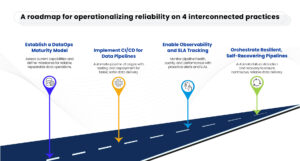
- Establish a DataOps Maturity Model
Begin by assessing your current state: Are pipelines ad hoc or orchestrated? Are deployments manual or automated? A DataOps maturity model helps teams identify gaps, set measurable milestones for testing, versioning, and deployment across environments. It becomes your north star, guiding teams toward structured, repeatable, and auditable data operations. It’s the difference between chasing issues and continuously improving reliability. - Implement CI/CD for Data Pipelines
Apply the rigor of DevOps to the data domain. Automate ingestion, transformation, and deployment workflows so every code or schema change moves through a controlled, testable, and traceable process. This not only accelerates delivery but also ensures that downstream BI dashboards and AI pipelines are always operating on validated, production-ready data, minimizing risk and manual rework. - Enable Observability and SLA tracking
Make data operations measurable. Instrument every pipeline with end-to-end visibility, to track data freshness, drift, latency, and quality metrics against SLAs. With proactive alerts and real-time dashboards, teams can identify anomalies before they cascade into business impacts. Observability transforms operations from firefighting to data reliability engineering, fostering accountability and trust in every data product. - Orchestrate Resilient, Self-Recovering pipelines
Even the best pipelines fail, but what matters is how fast they recover. Intelligent orchestration enables pipelines to detect, isolate, and self-recover from common failure scenarios. Modern platforms can automatically retry failed jobs, reroute workloads, or pause dependent processes until data integrity is restored. By combining monitoring with automation, organizations achieve continuous data delivery with minimal human intervention.
Together with these four practices, automation, observability, and orchestration converge to ensure continuous, trustworthy data flow across analytics and AI environments.
The Business Payoff: Reliability Becomes Velocity
Organizations that operationalize DataOps realize exponential gains in speed, agility, and confidence. Automated, observable pipelines minimize manual intervention while maintaining consistent data quality. When reliability is engineered into data operations, the impact is immediate and measurable.
- BI and analytics teams gain faster access to consistent, high-quality data.
- AI initiatives see improved model accuracy and trust.
- IT and business teams align around shared SLAs and clear accountability.
The result isn’t just operational efficiency, it’s confidence. Organizations no longer have to hesitate to act on insights because they trust the data behind them.
Charting the Path Forward
Start small, by assessing your current DataOps maturity: identify where automation and observability will have the most impact. Further introduce observability and incrementally extend automation toward end-to-end orchestration that connects ingestion to visualization.
Over time these steps converge into a DataOps-driven operating model, where data delivery is consistent, automated, and resilient enough to power analytics and AI at enterprise scale. Enterprises that take this journey now will build trusted, self-sustaining data ecosystems that empower analytics, BI and AI to deliver business value consistently and confidently.
As a data leader, get started on your Modernization and DataOps journey with an Enterprise Data Strategy Assessment led by experts at OwlSure. Click here to learn how OwlSure modernizes enterprise data estates, unifies data and enables trusted intelligence at scale.
Authors:
Venkata Bhaskar, Data Architect
Renji Krishnan, Senior Product Marketing Manager