

Executive Summary
In property and casualty insurance, fragmented customer and agent data often prevents insurers from gaining a complete understanding of interactions, behavior, and opportunities. Here we are highlighting how insurers can leverage insights to improve analytics, enable advanced segmentation, deliver personalized experiences, and uncover new opportunities for growth.
This blog explores how a Customer 360 framework helps unify structured and unstructured data to create a single, actionable view of customers and agents.
Introduction:
Imagine that all information about your customers and agents, both structured and unstructured, is stored in one central location. Further, imagine that every interaction with them is tracked in one place to paint a holistic picture of their journey with you. What if you could utilize this data to drive your sales & marketing campaign effectively? Identify new opportunities? Build personalized products? Delight your customers with perfectly designed personalized experiences?
This is what customer 360 can help you achieve. Customer 360 is a framework that consolidates all your fragmented customer data located in disparate databases and creates a single, unified, actionable profile of the customer. Customer 360’s goal is to create a single customer data hub thereby a single source of truth for everyone within the organization so they can serve their customers better and optimize their business policies.
Why Customer-360?
In P&C insurance, customers and agents transact with you via multiple channels & touchpoints. Making some sense of this data is itself an overwhelming task, let alone attempting to derive maximum value of it. Customer 360 comes in handy here as it works by turning complex & messy data into a clear & comprehensive view of the customer. Listed below are a few ways that highlight the importance of customer 360 in P&C insurance.
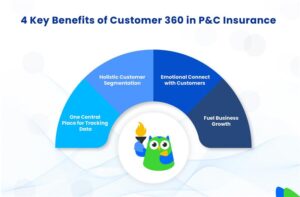
- Analytics: Customer 360 captures customers’ information from varied sources and in different formats. From initial lead form through submissions, email enquiries to cover purchases, renewals, billing and claim transactions, all interactions with the customer are tracked in one central place. Once the data is centrally collected, you can analyze the entire customer’s behavior, identify improvement opportunities thereby making data-driven decisions. Analyzing the data will serve all key organizational functions within the insurer. For example, the sales & marketing teams can rank & interact with the customers based on their worthiness, potential purchase possibility, or interest level with respect to products & services, claims team can minimize claim lifecycle by understanding customer behavior on litigations, product management team can build attractive products that are personalized to customer delight.
- Holistic customer segmentation: With customer 360, you can segment customers based on traditional & non-traditional methods, non-traditional being the key. Traditional insurance methods for segmentation include the utilization of demographic, firmographic, and geographic variables. Newer methods of segmentation include utilization of technographic, behavioral, and customer-value based segmentation.
An example of needs-based segmentation would mean that insurance companies would leverage data to understand the ‘risk profile’ of the customer and recommend tailored products & solutions that address the customer’s needs. This helps insurance companies and their agents to behave like trusted advisors to customers rather than coming across as someone selling their products and services. Even if insurance companies do not have products & services to fulfill the current needs of the customers, understanding the volume of inquiries registered by same segment of customers with similar risk profile will inform their judgement on whether to build a new product or partner with 3rd parties to deliver those products and services. - Emotional connect with customers: As per a survey by Genesys, 81% of the customers are likely to purchase if they are offered a personalized service. By segmenting the customers, insurers can bring specialization in solving those needs. An example for specialization would be to educate a customer in a language that is colloquial to segment the customer belongs. Education brings more awareness and connectivity, which in turn leads to proposals.
During proposal creation, converting insurance specific coverage jargons in a language understood by the customers during the negotiation phase can speed up the purchase process by building emotional connection with the customer. After a customer is acquired, insurers can continue to build loyalty by delivering quality education content to manage their risk. The more customers can minimize their exposures themselves by taking care of assets, the less the need to transfer them to the insurance company and the overall cost of insurance comes down. The insurance company here becomes a trusted enabler to make the customers self-reliant, thereby building further credibility. As per the Genesys survey 79% of those customers who receive personalized services can refer your products/ services to a friend or colleague. - Fuel business growth: Getting a 360-degree view of customers and their assets also means identifying potential new risks and thereby determining areas of unaddressed opportunities. These opportunities can be addressed by existing risk solutions that an insurer currently has in place or can be addressed by the development of new products & services. Similarly, getting a 360 degree agency can help identify new distribution opportunities that an agent isn’t currently appointed for.
Final Thoughts
Adopting a Customer-360 approach enables insurers to transform scattered data into meaningful insights that drive smarter decisions and stronger customer relationships. By leveraging unified data and advanced analytics, insurers can deliver more personalized experiences while unlocking new avenues for growth.