

Most service organizations can tell you how many work orders closed last month. Few can tell you what those work orders actually earned. That gap is structural, not a reporting delay: warranty costs get misclassified, parts get consumed without full reconciliation, and labor gets logged in the field but never reaches an invoice. None of it surfaces until month-end close, by which point the quarter is already decided.
Why Service Profitability Stays Hidden Until Month-End Close
Four conditions cause it.
Service is still treated as a cost center in most operating models: tracked for completion rates and response times, not for revenue or margin. It measures whether a work order closed on time. It rarely measures what the job was worth.
Revenue leaks out through three gaps: work performed but never billed, warranty claims misclassified and paid when they shouldn’t be, and parts consumption that never reconciles against procurement and cost. Each gap looks small alone. Across thousands of work orders a month, they add up fast.
Financial close runs late because service cost allocation is still manual. The finance team spends days each month piecing together labor, parts, and warranty data from systems that don’t talk to each other.
And there’s no single view. Labor cost sits in one system, parts cost in another, warranty and contract revenue somewhere else entirely. No one can pull up one profit and loss (P&L) statement for a job, a contract, or a technician and see the whole picture.
Seeing the Whole Picture: Six Capabilities That Connect Field Service to Finance
Modern field service platforms close these gaps by connecting service execution directly to finance, posting cost and revenue as they happen instead of waiting for month-end close.
Real-time cost and revenue posting between Field Service and Finance
Every labor hour, every part, every completed work order posts directly from Dynamics 365 Field Service into Dynamics 365 Finance as it happens. The close doesn’t wait on manual reconciliation. The numbers are already there.
Billing models that match how the work actually happens
Project Operations supports time-and-materials and fixed-fee billing side by side, so the model fits the engagement instead of forcing every job through the same structure.
Parts cost that reconciles automatically
Supply Chain integration tracks parts consumption, procurement, and landed cost as parts move through a job, closing the gap between what a part cost and what got billed for it.
Warranty claims that validate themselves
Automated entitlement validation checks a warranty claim against the contract terms before it’s paid, and flags recovery opportunities when a claim should be charged back to a manufacturer or supplier instead of absorbed as cost.
Revenue recognition that holds up under audit
Service contract revenue recognizes in line with IFRS 15 and ASC 606, so recurring revenue is recorded as it’s earned, not just when cash arrives.
One P&L Dashboard, Down to the Work Order Level
A single dashboard rolls up labor, parts, warranty, and contract revenue in one view, with drill-through to the work order, contract, or technician behind any number.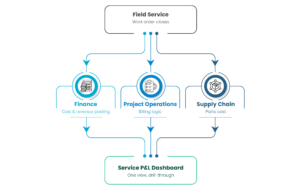
What Happens to a Work Order Before and After Connecting Field Service to Finance
Without that integration, a technician closes a work order. The labor gets logged. The parts get pulled from inventory. Weeks later, the finance team is reconstructing what the job cost and whether it was billed correctly, working from three systems that don’t share a common record.
With Field Service and Finance connected, the same work order posts its cost and revenue the moment it closes. If it’s billable, it flows straight into invoicing. If it’s a warranty claim, entitlement gets checked automatically and any recovery opportunity gets flagged. The finance team isn’t reconstructing the story weeks later. They’re watching it happen.
Organizations that connect field service to finance this way cut revenue leakage by up to 5%, gain visibility into warranty cost they didn’t have before, and replace fragmented, month-end reconciliation with one standing P&L.
The Dynamics 365 Modules That Power a Single Service P&L
The connection runs through the platform, not around it. Dynamics 365 Field Service posts cost and revenue directly into Dynamics 365 Finance as work orders close. Project Operations handles billing logic for time-and-materials and fixed-fee work. Supply Chain Management tracks parts from procurement through consumption to landed cost. Warranty claims run through automated entitlement checks instead of manual review. Contract revenue recognizes against IFRS 15 and ASC 606 as it’s earned. All of it rolls into one dashboard that shows the P&L down to the work order level, not just the quarter.
What Real-Time Service Margin Visibility Is Worth
Most service organizations lose 4 to 6% of revenue to unbilled work and warranty misclassification, and most don’t know it until the numbers are already baked into a quarterly report nobody can act on.
Service is usually the largest point of contact a company has with its customers. It should also be the most transparent part of the business, not the part finance has to reconstruct after the fact.
OwlSure’s Field Service practice connects field execution to Dynamics 365 Finance, Project Operations, and Supply Chain, building the P&L view that turns service delivery from a cost center into a measurable, margin-positive part of the business.